

Space investments offer opportunities to profit as entrepreneurs reach for the stars with business ideas that literally can seem out of this world.
One of the space investments that offer opportunities to profit is Arlington, Virginia-based AeroVironment, Inc. (NASDAQ: AVAV), which announced Nov. 19 that it will acquire BlueHalo from Arlington Capital Partners in an all-stock transaction valued at approximately $4.1 billion. The combined company will provide intelligent, multi-mission autonomous robotic systems, serving defense, government and commercial customers.

Chart courtesy of www.stockcharts.com
AeroVironment provides technology solutions at the intersection of robotics, sensors, artificial intelligence (AI), software analytics and connectivity. With a purpose to secure lives and advance sustainability through transformative innovation, the company offers uncrewed aircraft systems, loitering munition systems, uncrewed ground vehicles and high-altitude pseudo-satellites.
Space Investments Offer Opportunities to Profit: All-Stock Aquisition
The all-stock acquisition will provide product diversification into space technologies, counter-UAS, directed energy and electronic warfare (EW), AeroVironment announced. The seller’s willingness to accept an all-stock transaction is a major vote of confidence for the long-term business prospects for the combined companies, AeroVironment officials added.
“Given the increase in drone attacks across ongoing conflicts, counter-UAS systems are becoming increasingly important, the Chicago-based investment firm William Blair wrote in a research note. “In particular, programs such as Replicator 2.0 focus on fielding counter-UAS systems at scale. BlueHalo’s directed energy and electronic warfare capabilities also add low-cost per shot offerings that are being heavily invested in by the DoD. The acquisition also adds diversification for AeroVironment, in that almost all of BlueHalo’s revenues come from domestic programs, so there is no outsized exposure to the war in Ukraine.”
BlueHalo has capabilities serving multibillion-dollar markets and the combined company will gain roughly four-times expansion of the total addressable market, the William Blair analysts opined. BlueHalo has a key role of the $1.4 billion Satellite Communications Augmentation Resource (SCAR) program, LOCUST, and U.S. SOCOM Counter UAS programs, the analysts added.
BlueHalo expects to generate more than $900 million in revenue this calendar year and has grown at an 18% compound annual growth rate (CAGR) for the past seven years, William Blair wrote. While earnings before interest, taxes, depreciation and amortization (EBITDA) was not explicitly provided, based on management commentary during the Nov. 19 conference call, the investment firm estimates that BlueHalo has a fairly similar margin profile to AeroVironment in the mid-teens.
“BlueHalo has funded backlog worth approximately $600 million and total backlog worth more than $2.5 billion,” William Blair noted. “Pro forma net leverage for the acquisition increases to 2.5 times, and the company targets a leverage range of 1.0 times to 1.5 times over the long term. Management expects the acquisition to be accretive to revenue, adjusted EBITDA, and non-GAAP EPS, and anticipates approximately $20 million of long-term cost synergies.”
Space Investments Offer Opportunities to Profit: SpaceX
At the 31st Annual Baron Investment Conference on Friday, Nov. 15, the mutual fund company’s founder and Chief Executive Officer Ron Baron repeated his refrain that he and his fellow portfolio managers invest in dedicated and innovative people, not organizations. Baron told attendees that he started to invest in SpaceX in 2017.

Paul Dykewicz meets with Ron Baron.
“We now have exponential growth,” Baron said.
Certain Baron mutual funds hold shares in privately issued SpaceX, giving investors willing to buy shares in a broadly focused fund that includes exposure to the reusable launcher and satellite broadband services company. As of Baron’s Sept. 30 quarterly update, SpaceX, also known as Space Exploration Technologies Corporation, and its weightings in each fund that held shares in the private company were: Baron Asset Fund (2.8%), Baron Fifth Avenue Growth Fund (1.0%), Baron Focused Growth Fund (8.9%), Baron Global Advantage Fund (6.5%), Baron Opportunity Fund (2.7%) and Baron Partners Fund (11.1%).
Competitors still are using expendable launchers that can only perform one mission, not the repeated trips to space of a Starship rocket, Baron told the attendees at his annual conference held at the Metropolitan Opera House in New York.
SpaceX reuses its rockets, whereas other launchers have expendable boosters that are used just once for $100 million-$200 million for a single mission.
“Then it’s gone; it burns up,” Baron said.
SpaceX’s next-generation Starship rocket is designed to be used “over and over again,” Baron told the attendees.
Space Investments Offer Opportunities to Profit: CEO Shotwell Speaks
“Starship is going to change the world, both on planet Earth and off,” said Gwynne Shotwell, president and chief operating officer of SpaceX.
“The difference between Starship and this other extraordinary product that we have called Falcon 9 is both the first stage and the second stage of Starship is reusable,” Shotwell said.

Paul Dykewicz speaks with Gwynne Shotwell, president and chief operating officer of SpaceX.
The “big breakthrough is reusability,” Shotwell emphasized.
Elon Musk created the company in 2022 with the singular purpose and sole vision to build the transportation systems necessary to put people on other planets, Shotwell continued.
“His vision is currently on Mars but we’re all starting to look beyond Mars, as well,” Shotwell said. “If you think about traditional rockets, they are both first stage and second stage. The first stage gets dumped in the ocean. The second stage generally gets dumped on orbit.
“Starship will change everything,” Shotwell counseled. “The cost of getting people and cargo to orbit will drop dramatically. We’re not throwing out the rocket, neither part. The Falcon first stage comes back. The second stage we bring back.”
The fairing, a nose cone used to protect a spacecraft payload against pressure and aerodynamic heating during launch through an atmosphere, is returned, Shotwell continued.
On Nov. 19, SpaceX conducted its sixth test flight of the Starship with President-elect Donald Trump present at the launch site in Texas with company founder Elon Musk. The reusable rocket blasted into the sky on schedule and roared above the Earth.
However, the two sections of the Starship rocket splashed down on opposite sides of the world. The Heavy Booster fell into the Gulf of Mexico, while the Starship dropped into the Indian Ocean off the coast of Australia. But the pincer-like “chopstick” catch of the booster, which was achieved during the fifth test flight, was not attempted due to a safety parameter not checking out.
“Think about what life would be like if aircraft were one-time use,” Shotwell asked rhetorically.
Space Investments Offer Opportunities to Profit: Regulatory Hurdles
One of the biggest challenges is receiving regulatory approval for launches, Shotwell said.
“Technology is easy,” Shotwell commented. “Physics is easy. People are hard. And regulatory people are the hardest.”
SpaceX conducted 96 launches last year and projects to complete 130 missions in 2024, Shotwell said.
Much of the company’s business comes from government contracts, Shotwell said.
“We work for the government in so many ways,” Shotwell said. “The government is an extraordinary customer for us, both the Department of Defense as well as NASA. I think we’re NASA’s largest contractor. NASA is our largest customer, or at least the last time I looked, they were. We are NASA’s customer. We actually pay NASA to do some work for us. We also do some technology development partnerships. Our relationship with NASA is really extraordinary.”
SpaceX has obtained $22 billion of federal government contracts through competitive bidding, Shotwell said.
“We earned that; we bid it and were the lowest price and the best bidder,” Shotwell said. “We won and we execute. It is not a bad thing to serve the U.S. government with great capability and products.
“If we [the United States] is in a conflict and the [federal] government needs Starlink for capacity, we are not going to say, ‘No, actually rather have the country get overrun. Nah, we want to keep our customer base.’ It’s just not going to happen. If the government needs it, the government will get what it needs.”
Space Investments Offer Opportunities to Profit: Starlink Broadband
“Our vision and where we are going is very clear,” Shotwell told the attendees. “Starlink might seem like a side project. It’s not a side project. It’s necessary once we get to Mars that there is a communication system.”
Starlink’s mission includes building the systems necessary to produce satellites that will serve settlements of humans on other planets, Shotwell said.
Space Investments Offer Opportunities to Profit: Set ‘Crazy Goals’
Musk’s passion is to ensure that humanity survives. To keep SpaceX’s more than 15,000 employees focused on achieving lofty goals, Shotwell said she adheres to the following:
- Set a single focus and a vision keeps people “pretty tightly” in line.
- Hire the best people, not the best people that you can, but the best people. If you can’t fill a role. Don’t fill it. Don’t compromise on that.
- Set “really crazy goals.” What seems impossible is good to set as a goal because it keeps people moving really fast. If the right people are hired, they are motivated and want to do really good work. Give them a really hard job and let them run.
“I love my job because I work with 15,000 extraordinary people of all shapes and sizes, all technical areas,” Shotwell said. “It is the best place to work, frankly. You don’t want to work at a company where people are slow and stodgy. It is very energizing and very motivating to work with really smart people.
Shotwell said he likes “mouthy” employees. She cannot solve problems that she does not know about.
“I really want to hear where we’re screwing it up,” Shotwell said. “That’s really important.”
The company’s culture is “super-hard charging, hard-moving and smart,” Shotwell said.
Space Investments Offer Opportunities to Profit: My Question to CEO Shotwell
During a question-and-answer segment at the Baron Investment Conference, I asked Shotwell to provide some “color” about how SpaceX is going financially with its low-Earth-orbit system, since many others before it became financial flops. Iridium and Globalstar both went bankrupt before restructuring and ultimately becoming profitable after the early investors lost their money.
“We are going to make some money on Starlink this year; I can say that,” Shotwell said. “We’ve had quarters of making money on Starlink in the past. The chip technology has developed to the point where it’s easier to be successful now. I credit my team as well. We have an extraordinary team of engineers, techs and other folks building the satellites with incredible technology.”
All those factors tie into ensuring that SpaceX’s low-Earth-orbit business is successful, Shotwell said.
“I’m not going to talk about our financials,” Shotwell said. “I think the future is incredibly bright.”
“Since 2018, we are five or 10 x what we were then,” Shotwell said. “That’s not faith. The company is incredibly valuable.”
Shotwell offered guidance that Starlink will add a “zero,” probably at least, as the system continues to grow.
“I think that Starship will be the thing that takes us over the top, as one of the most valuable companies,” Shotwell said. “We can’t even envision what Starship is going to do to humanity and human lives. I think that will be the valuable part of SpaceX.”
Ron Baron followed up by saying he has been able to look at the financials of SpaceX as an investor in the privately held company.
“Since we started investing in SpaceX in 2017, we have made seven times our money,” Baron told attendees. “We now have investments that are worth $2.8 billion that cost us a little over $1 billion.
“We continue to invest in every one of their offerings. We think that we will triple our money over the next five years. We think that in the 2030s, we can make five times again. From current levels, based upon what our projections are and based upon the information that has been provided to us, we think that we are going to make 15 times our money again over the next 15 years.”
Elon Musk views Baron’s projections as “very conservative [compared] to his goals, Ron Baron said.
Mark Skousen, PhD, a Baron client and the head of the Forecasts & Strategies investment newsletter and several trading services, has been a big fan of the company’s funds for many years. The Baron Investment Conference, in particular, has been one of his favorite annual events to attend due to the access to the company’s key leaders, portfolio managers and even the CEOs of top companies like SpaceX.
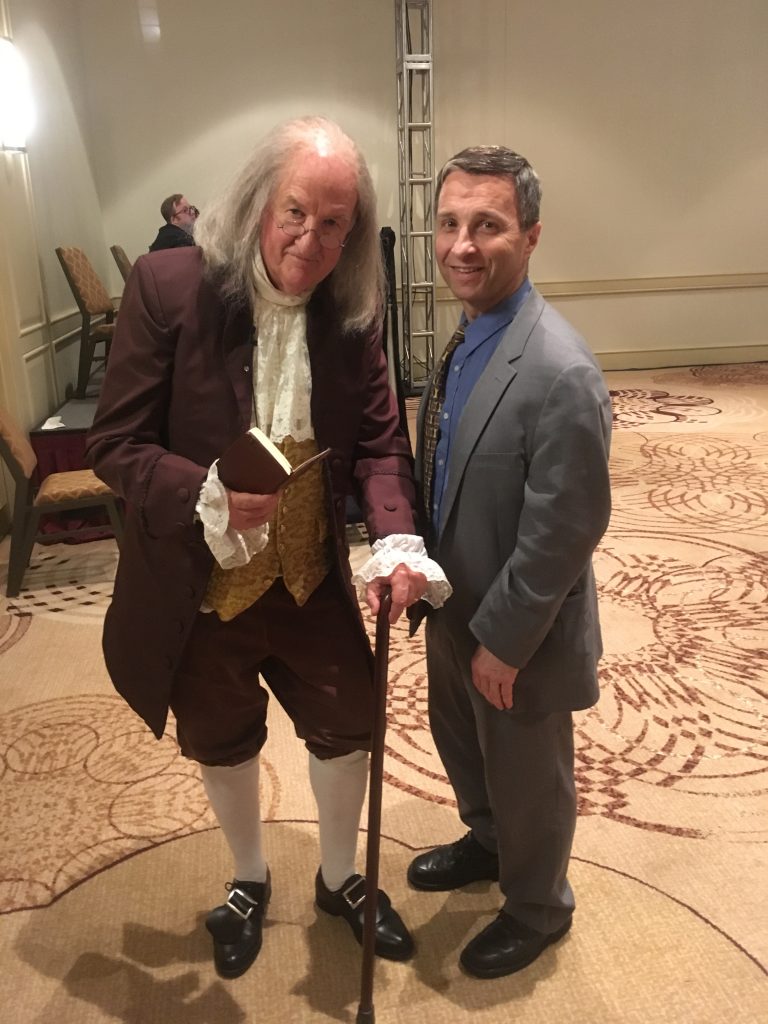
Mark Skousen, head of TNT Trader and scion of Ben Franklin, talks to Paul Dykewicz.
For investors who aspire to buy shares in promising space investments offering opportunities to profit, AeroVironment, Inc. and SpaceX are two companies worth finding a way to ride.
Paul Dykewicz, www.pauldykewicz.com, is an award-winning journalist who has written for Dow Jones, the Wall Street Journal, Investor’s Business Daily, USA Today, the Journal of Commerce, Crain Communications, Seeking Alpha, Guru Focus and other publications and websites. Paul can be followed on Twitter @PaulDykewicz, and is the editor and a columnist at StockInvestor.com and DividendInvestor.com. He also serves as editorial director of Eagle Financial Publications in Washington, D.C. In that role, he edits monthly investment newsletters, time-sensitive trading alerts, free weekly e-letters and other reports. Previously, Paul served as business editor and a columnist at Baltimore’s Daily Record newspaper and as a reporter at the Baltimore Business Journal. Plus, Paul is the author of an inspirational book, “Holy Smokes! Golden Guidance from Notre Dame’s Championship Chaplain,” with a foreword by former national championship-winning football coach Lou Holtz. The uplifting book is endorsed by Joe Montana, Joe Theismann, Ara Parseghian, “Rocket” Ismail, Reggie Brooks, Dick Vitale and many other sports figures. To buy signed and specially dedicated copies, call 202-677-4457.